
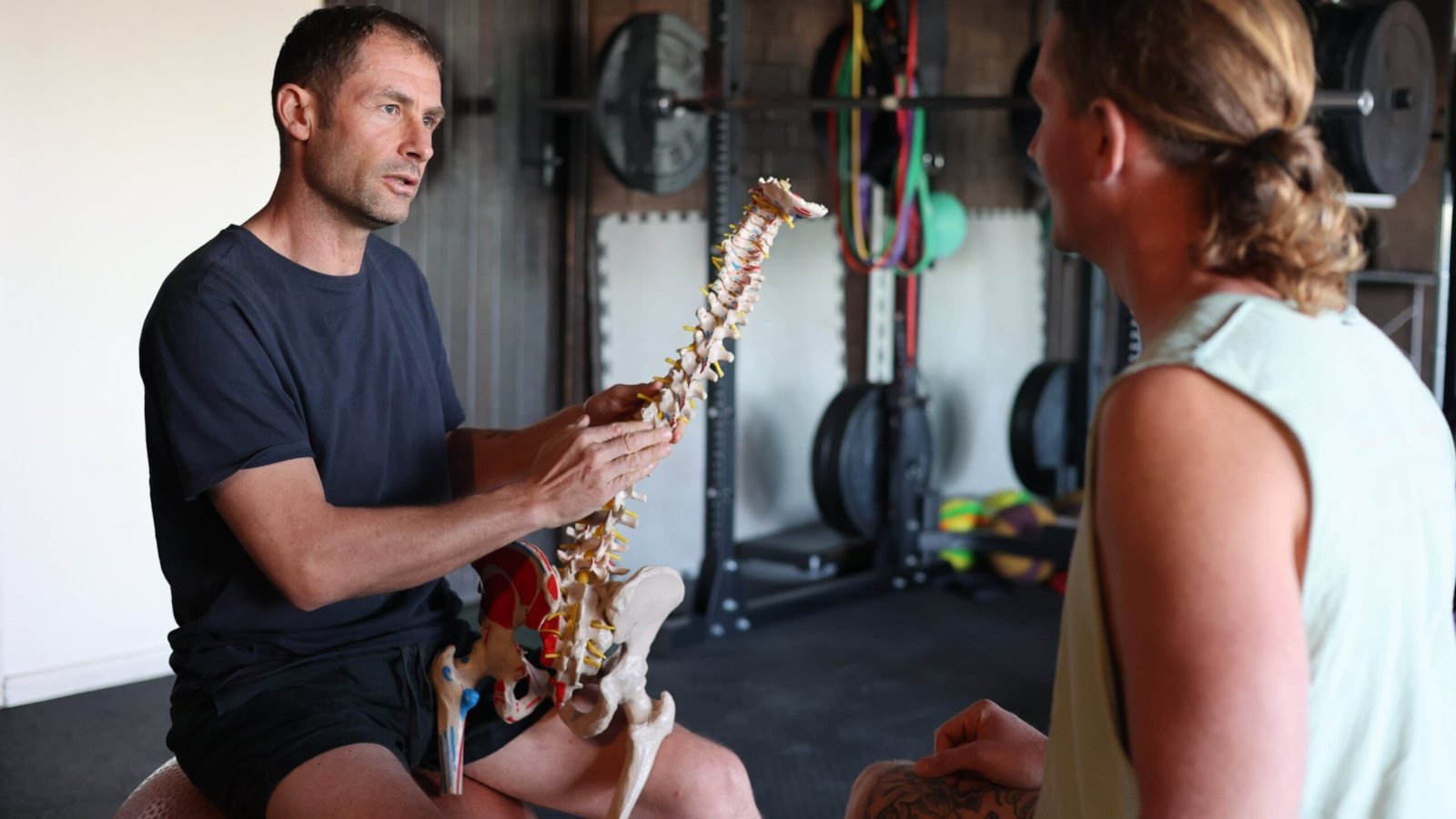
Most surfers never think about their squat. Yet almost everything you do on a wave, from the pop-up to a deep bottom turn, is a variation of it. The squat is one of the most fundamental movement patterns the human body has. When it works well, it underpins your balance, your power and a back that holds up through years of paddling. When it doesn’t, your body finds a way around the problem, and that workaround follows you into the water.
Why the Squat Matters for Surfers
Surfing asks a lot of your lower body: strength, stability and mobility, all on a surface that never stops moving. A well-trained squat builds each of these:
- Balance and stability. Stronger legs keep you centred on the board and help you absorb whatever the wave throws at you.
- Speed and power. Stable legs give you a solid base to generate speed and drive through your turns.
- Control of your joints. Good squat mechanics teach your body to manage the forces going through your ankles, knees and hips, which helps you perform in bigger conditions and reduces your risk of injury.
- A more supported back. Squatting well strengthens the muscles around your spine. That matters for surfers, whose lower backs already work hard from the repeated arching of paddling.
- Longevity. A strong, efficient squat pattern is part of what keeps you surfing well into your 50s, 60s and beyond.
Studies on competitive surfers have linked lower-body strength with higher-scoring turns, which reflects what most experienced surfers already feel in the water: strong legs make a difference.
How Your Squat Shows Up on a Wave
The pop-up
The pop-up is essentially a fast, compressed squat. You go from lying on the board to a balanced stance in a split second, which takes lower-body strength and core stability working together. If your hips or ankles are stiff, or your legs lack strength at the bottom of a squat, your pop-up will be slower and less stable.
Staying balanced
Once you’re up, you’re constantly adjusting your centre of gravity. That means continual bending and straightening at the knees, hips and ankles, exactly the movements the squat trains. A strong, adaptable squat lets you stay low and respond to the wave instead of being thrown around by it.
Turns and manoeuvres
Bottom turns, cutbacks and riding the barrel all need you to compress and extend, much like a repeated squat. Getting low through a turn lets you engage the rail and generate both power and control. If your squat depth is limited, often by stiff ankles, your turns will be too.
Pumping for speed
Generating speed on flatter sections relies on rhythmic up-and-down movements that resemble repeated partial squats. Even this subtle movement benefits from a well-trained pattern.
| Surfing action | What it needs from your squat |
|---|---|
| Pop-up | Depth, stability, power |
| Staying balanced | Stability, control |
| Bottom turn | Lower-body strength, depth |
| Rail turn | Range of motion, power |
| Pumping for speed | Dynamic, repeated movement |
The Path of Least Resistance
When one of your joints doesn’t move well, your body won’t stop the movement. It takes the easiest available route to finish it. If your ankles or hips can’t give you the depth you need, you might round your lower back or let your knees cave inward instead.
These compensations don’t stay in the gym. A surfer with stiff hips may land the pop-up with their feet too close together and a shaky stance. A surfer with weak legs may lean on their upper body for balance, burning energy and tiring early. And if you can’t get into a deep, controlled position, you can’t fully engage the rail in a turn.
Getting to your feet isn’t the same as getting there well. You can complete a pop-up with an over-arched back and an unstable stance, but that costs you control, power in your next manoeuvre and resilience over time. The question isn’t just whether you can do a movement, but how you do it.
These patterns also add stress to your joints. Knees that cave inward (known as knee valgus) load the inside of the knee, and the same pattern tends to appear every time you bend your legs on a wave. A lower back that rounds under load adds to the strain on a back that’s already working hard from paddling and twisting. Cleaning up your squat is one of the most practical things you can do to look after your body in the water.
What’s Really Limiting Your Depth
For most surfers, a shallow squat comes down to muscle imbalances and muscles that aren’t switching on properly, rather than their anatomy. Surfing itself tends to build some predictable patterns:
- Strong paddling muscles through the back and shoulders, with a tight chest and front of the shoulders.
- Quads that do most of the work, with glutes and hamstrings that are relatively under-active.
- Stiff hips that restrict how far you can fold at the bottom of the squat.
- A core that doesn’t stabilise your spine and pelvis well through the movement.
- Stiff ankles, often from old injuries, that stop your knees travelling forward.
Your skeleton does play a part. Things like the length of your thigh bone and the shape of your hip sockets influence how deep you can squat and what your best squat looks like. But for the vast majority of surfers, the limits are trainable, which means there’s a lot of room to improve.
Why Stretching Alone Won’t Fix Your Squat
To fix your bodyweight squat, you don’t need a special stretching regime or a complicated exercise program. Flexibility matters, but there’s a difference between passive flexibility (how far a joint can move when something pushes it) and active mobility (how far you can move it yourself, with strength and control).
A good squat needs active mobility. Lengthening a muscle with stretches doesn’t teach your body how to use that range inside a complex, multi-joint movement. What usually works far better is practising the squat itself with good technique, while addressing the specific restrictions in your ankles, hips and upper back and building strength in the muscles the squat relies on. Think of the squat as a skill to practise, not just a test of flexibility.
Your Body Is Designed to Squat
The deep squat is a natural human position. Toddlers drop into it effortlessly, and in many cultures it’s still an everyday resting posture. Most adults lose it through years of sitting and moving less, not because of a structural problem. That’s good news: what’s been lost through disuse can usually be regained.
When you squat with good form, you activate, stretch and strengthen the muscles that weren’t doing their job before. The key points:
- Keep your weight balanced over the middle of your feet.
- Start the movement by sending your hips back and down.
- Keep your spine long and your core braced.
- Let your knees track in line with your toes.
Practised consistently, good technique becomes self-correcting. It shows you where your weak links are and trains them at the same time.
Three Simple Tools to Rebuild Your Squat
1. A stool or box
Choose a height that lets you squat with good form, even if that’s well above parallel. Lightly touch the stool with your glutes and stand back up, keeping your spine neutral, your core engaged and your knees tracking over your toes. As that becomes comfortable, lower the height over the following sessions. The stool gives you a clear target and a safe way to build depth step by step.
2. A suspension trainer (such as a TRX)
If balance or strength is holding you back, a suspension trainer lets you use your arms as a counterbalance. Stand facing the anchor point with your feet about shoulder-width apart, hold the handles with palms facing each other, and lean back slightly to take up the tension. Sit your hips back and bend your knees, keeping your core engaged and your back long, and use the straps to help control both the way down and the way up. As you improve, adjust your body angle to make it harder, and progress to assisted single-leg squats.
3. A stick or broom handle
A simple stick gives you instant feedback on your posture:
- Overhead: hold it above your head with a wide grip and keep it directly overhead as you squat. This keeps your chest open and stops you tipping forward.
- Along your back: hold it so it touches the back of your head, your upper back and your tailbone. Keep all three points of contact as you squat to maintain a neutral spine.
- In front: hold it at chest height as a counterbalance to help you sit deeper.
Whichever tool you use, form comes first. The aim is to reinforce good technique, not to force depth you can’t control. Quality of movement always beats the number of reps or how low you go.
Taking Your Squat Into Your Surf Training
Once your bodyweight squat is solid, you can progress to variations that match what surfing demands:
- Single-leg squats for the one-sided balance and stability surfing needs.
- Jump squats for the explosive power behind a fast pop-up.
- Rotational squat variations for the core strength that drives powerful turns.
- Front squats, which challenge your core and upper back and help your paddling posture.
A few bodyweight squats before a session are also a simple way to wake up your legs and hips before you paddle out. As always, keep the same standard: technique first, then load and complexity.
Squat Smarter, Surf Longer
A good squat isn’t just another exercise. It’s a foundation for better surfing, fewer injuries and more years in the water. Focus on the quality of every rep, use simple tools like a stool, a suspension trainer and a stick to refine your technique, and build from there into surf-specific strength training.
Want to know what’s holding your squat back? I look at exactly this in every assessment. You can start with the free 6-week strength program for surfers, learn more about personal training in Byron Bay or injury rehab, or book your free 45-minute consult.
Add a Comment